

Table of Contents
- Why Versatile Clothing Pieces Beat a Closet Full of Single-Use Items
- Start With a Wardrobe Audit and a Capsule Wardrobe Essentials List
- How to Dress Professionally While Working From Home (and Still Look Right at the Office)
- The Best Fabrics for Durable Clothing That Survives Real Life
- Layering Techniques That Make One Piece Work in Three Seasons
- Cost-Per-Wear: The Math That Justifies Buying Better Versatile Clothing
- Fit, Body Type, and Climate: Matching Versatile Pieces to Your Actual Life
- Frequently Asked Questions
Last Updated: September 14, 2026
Why Versatile Clothing Pieces Beat a Closet Full of Single-Use Items
Most closets are graveyards of one-time purchases: the novelty blazer worn twice, the statement pants that matched one top. Building around tips for picking versatile clothing pieces flips that math, fewer items, more combinations, less decision fatigue. This guide from Nested Peak covers how to audit what you own, choose fabrics that survive real wear, and layer pieces across seasons so one garment earns its keep three times over. The payoff goes beyond a tidier closet: less spending, simpler laundry, and looking put together whether you're on a call, on a course, or on a boat.
The core idea is simple: versatility is a property you select for, not one you stumble into. A garment is versatile when it works across at least two settings, layers under or over something else, and holds up to repeated washing. Buy on that standard and your closet shrinks while your options expand.
Start With a Wardrobe Audit and a Capsule Wardrobe Essentials List
A wardrobe audit is a systematic review of what you own, what you actually wear, and what's blocking you from getting dressed quickly. Most guides stop at "make three piles", the starting point, not the method. What changes buying behavior is adding a wear-count log and a cost-per-wear sort.
Step 1: The wear-count log. Before you pull anything out, spend two weeks tallying every time you wear a garment in a notebook or phone note. Two weeks is short enough to finish and long enough to expose what you reach for on autopilot. Most people find roughly 20 percent of their closet accounts for about 80 percent of their wears (pubmed.ncbi.nlm.nih.gov).
Step 2: The three-pile sort, with a fourth pile. Pull everything out and sort into worn in the last two weeks, worn in the last year, untouched in a year, and damaged-but-fixable. The fourth pile matters: a loose button or stretched collar is often why a piece fell out of rotation, not because it was a bad buy.
Step 3: The cost-per-wear sort. For each keep-pile item, divide the price paid by the wears you logged (scaled to a year). A $120 jacket worn twice a week for a year costs about $1.15 per wear; a $40 top worn three times costs about $13 per wear (consumer.ftc.gov). Sort by that number and the pattern is clarifying: the pieces you thought were bargains are often the most expensive things you own.
Step 4: Build the essentials list from the survivors. A capsule wardrobe essentials list is a short inventory of the pieces that do the heavy lifting for your specific life. For an active professional, that list usually includes:
- Two to three neutral base layers (tees, long-sleeve knits)
- One structured mid-layer that reads polished, like a quarter-zip
- One weather-resistant outer layer
- Two pairs of pants that move (one casual, one office-ready)
- One pair of shoes that works for both
Test each candidate against a simple question: can I wear this to at least three places I actually go? If the answer is no, it stays off the list.
Step 5: Deal with the discards deliberately. The untouched pile is not trash, it's inventory. Sort it into three channels: resell (consignment shops, online resale platforms, and brand trade-in programs take clean, current-season pieces), donate (local shelters and clothing banks accept wearable items year-round), and textile recycling (worn-out or stained items go to municipal textile drop-offs or retailer take-back bins, not the trash). Reselling the untouched pile often funds the first versatile purchase outright, turning the audit into a self-financing exercise rather than a purge.
How to Dress Professionally While Working From Home (and Still Look Right at the Office)
The trick to looking professional on video and in person with the same wardrobe is choosing pieces that read as intentional rather than athletic. A structured quarter-zip over a collared shirt does that; a loose hoodie does not.
Start with silhouette: look for a defined shoulder and a clean line through the body. A matte, midweight knit photographs better on camera than shiny performance material and looks appropriate in a meeting room. Keep color in a tight neutral range so any two pieces you grab work together.
Then build the outfit in layers so you can adjust for context:
- Base layer: a plain tee or long-sleeve in a neutral tone.
- Mid-layer: a quarter-zip or fine-knit sweater. This is the piece that carries the look.
- Outer layer: a clean jacket you can remove indoors without losing the outfit.
That structure means the same three pieces handle a morning of video calls, an afternoon at a client site, and a casual dinner afterward.
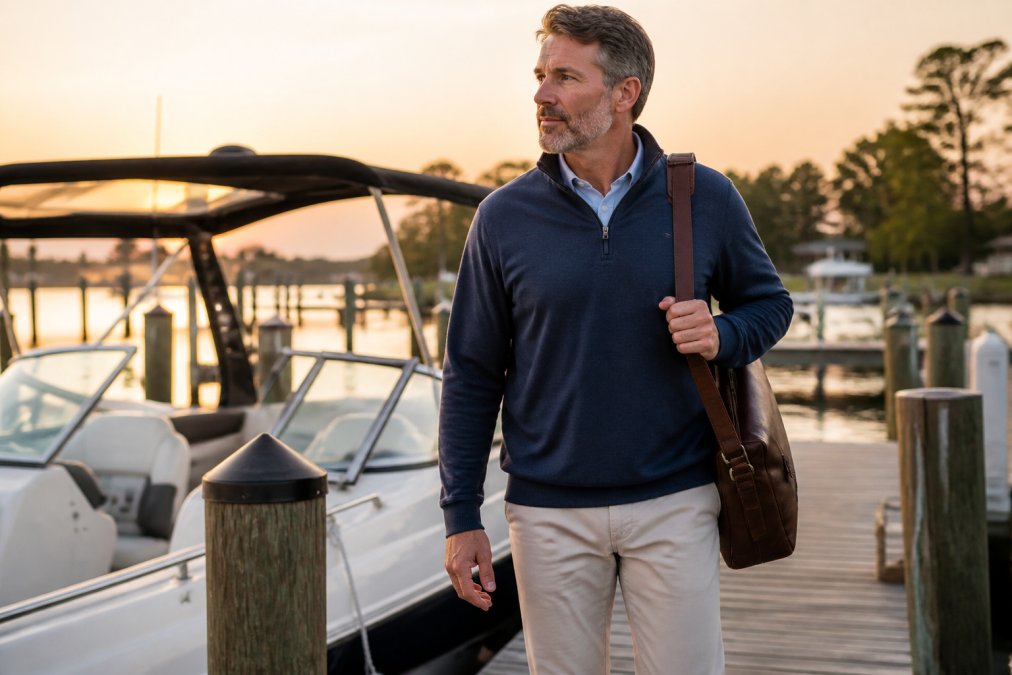
The NP Men's Quarter-Zip is built for exactly this: a clean, structured silhouette with a quarter-zip closure for adjustable ventilation, so it works over a collared shirt in the office and over a tee on the weekend. It's a layering piece first, which is what makes it earn its place in a small rotation.

The Best Fabrics for Durable Clothing That Survives Real Life
Fabric quality decides whether a piece lasts two seasons or ten. Evaluate three things: fiber content, weight, and construction.
Natural fibers and quality blends hold their shape and resist pilling better than thin synthetic knits (pubmed.ncbi.nlm.nih.gov). Midweight fabric drapes better and hides wrinkles, which matters when a piece goes from a car seat to a conference table. Construction shows in reinforced seams, a stable collar that doesn't collapse, and hardware that isn't flimsy.
A practical test before you buy: stretch the fabric gently and let go. If it springs back and holds its shape, it will survive wear. If it stays stretched, it won't.
Garment care is the other half of durability: wash cold, dry low, and fold knits instead of hanging them. Treating three good pieces well beats replacing ten cheap ones every year.
Layering Techniques That Make One Piece Work in Three Seasons
Layering turns a single garment into a three-season tool: thin, removable layers let you add or shed warmth without changing your whole outfit. But the generic "base, mid, shell" formula breaks down once you factor in where you live and how you're built. Two adjustments make it work.
Adjustment 1: Build the layer stack for your climate, not a generic one. The same three-piece structure produces very different garments depending on the weather you're dressing for.
- Hot and humid: the mid-layer is the problem, not the solution. Prioritize a breathable, moisture-wicking base and a single ultralight shell that blocks sun and rain without trapping heat. Skip insulation most of the year; keep one packable insulated vest for cold snaps.
- Cold and dry: insulation is the workhorse. A packable insulated mid-layer plus a wind-resistant shell handles most of the year, with the base layer managing moisture. Look for a hood and a cinchable hem, because wind ruins a good stack.
- Temperate and variable: the classic three-thin-layer formula earns its reputation here. A base, a midweight knit or fleece, and a light shell cover a 40-degree swing in a day. The mid-layer is the pivot, added and removed most often, so invest there.
- Wet and mild: water resistance beats warmth. A water-repellent shell and quick-drying base do more than any insulation, because a soaked mid-layer stops insulating.
Adjustment 2: Match the layer stack to your silhouette. Versatility is not body-neutral, and most guides pretend it is. The same three pieces read differently depending on proportion.
- If you're shorter or have a shorter torso: keep layers close to the body and avoid long hems that break the vertical line. A cropped or hip-length mid-layer over a straight-leg pant reads taller than a long tunic over a tapered one.
- If you're taller or longer-torsoed: you can carry longer layers and bulkier mid-layers without losing proportion. A hip-length shell over a mid-layer hitting at the waistband keeps the line clean.
- If you're broader through the shoulders or chest: size for the widest point and let a tailor take in the waist. A defined shoulder and straight torso line flatter more body types than a boxy cut, which adds width, or an overly slim cut, which pulls and gaps.
- If you're curvier through the hip: look for mid-layers that end above the widest point of the hip, and shells with a two-way zip so you can open the bottom for movement without losing the top closure.
The mid-layer is still the pivot. A fleece vest keeps your core warm while your arms stay free, suiting high-output activity and an office chair equally well. The NP Women's Value Fleece Vest is a good example: midweight fleece, a zip front, and a relaxed fit that moves without binding, layering over a long sleeve when the air turns and coming off cleanly indoors.

For colder starts, a packable insulated vest adds warmth without bulk. The NP 26 Men's Puff Vest uses lightweight insulation with a water-repellent shell and packs into its own carrying pouch, which makes it easy to keep in a bag for the temperature swing between morning and afternoon.
Cost-Per-Wear: The Math That Justifies Buying Better Versatile Clothing
Cost-per-wear is the purchase price divided by the number of times you actually wear a garment. A $60 piece worn 60 times costs a dollar per wear; a $30 piece worn five times costs six dollars per wear. That calculation reframes the whole buying decision: the cheaper item is often the more expensive one.
Run the math before you buy: estimate realistic wears per month, multiply by the months it should last, and divide the price by that number. A piece that works in three settings gets worn far more often than a single-use item, pushing its cost-per-wear down even at a higher sticker price.
This is where versatility pays for itself. A jacket that goes to the office, the course, and the boat gets worn three times as often as one that fits a single context, so its true cost is a fraction of the alternative. The NP Men's Basic Windbreaker Jacket is built on that logic: a wind- and light-rain-resistant shell that's lightweight and packable, with a clean silhouette that layers over anything. One outer layer, three environments.

Fit, Body Type, and Climate: Matching Versatile Pieces to Your Actual Life
Versatility only works when the piece fits your body and your weather. A garment that's technically multi-purpose but cuts wrong or suits the wrong climate will sit in the closet.
Fit comes down to tailoring and proportion. If you're between sizes, size for the shoulders and chest and have the length adjusted, a tailor can take in a waist far more easily than add room across the back. Look for a defined shoulder and a straight line through the torso; those flatter more body types than boxy or overly slim cuts.
Climate changes the calculus too. In hot, humid regions, prioritize breathable mid-layers and a light shell over heavy insulation. In cold climates, invest in a packable insulated layer and a wind-resistant outer shell you can stack. The pieces differ, but the structure is the same: a neutral base, a flexible mid-layer, and a protective outer.
Nested Peak designs and finishes its active-casual pieces in the USA, built by a husband-and-wife team around a simple idea: wear it up, wear it down. Judge a smaller brand by construction and wear count, not the label.
Building a versatile wardrobe is a discipline, not a shopping spree. The hard part is resisting the single-use purchase and holding out for the piece that works in three places and survives a hundred washes. That's the standard Nested Peak builds to: made-to-order active-casual apparel designed and finished in the USA, with durable construction that moves from the boat to the course to the office. Start with one piece that layers over everything you already own, wear it hard, and let the cost-per-wear math make the case for the next one. Get started with Nested Peak and build a closet where every piece earns its place.
Frequently Asked Questions
What is the most versatile piece of clothing to own?
A structured quarter-zip or midweight vest is the most versatile single piece for most wardrobes. It layers over a button-down for client meetings, works over a t-shirt on the course, and adds core warmth on the boat without restricting your arms. Look for a clean silhouette and a fabric that holds its shape after repeated washing. One piece that covers three settings replaces three pieces that each cover one.
How do you identify high-quality, long-lasting clothing?
Check three things: fabric weight, seam construction, and how the garment holds shape after washing. Dense knits and tight weaves resist pilling better than loose ones. Look for reinforced stitching at stress points like shoulders and side seams. A garment that keeps its silhouette through 50 washes costs less per wear than a cheaper piece that sags after five. Fit and construction matter more than the label.
How many items do you need for a functional capsule wardrobe?
Most people land between 25 and 40 pieces including shoes and outerwear. The exact number matters less than the ratio: aim for roughly 70 percent neutral basics and 30 percent pieces with personality. Every item should pair with at least three others in the closet. If a piece only works with one outfit, it is not earning its space. Start with your capsule wardrobe essentials list and add from there.
Can one piece of clothing really work for the office, the golf course, and the boat?
Yes, if you pick the right piece. A clean quarter-zip in a solid neutral color reads as business casual over a collared shirt and as athletic wear over a t-shirt. The key is silhouette and fabric: structured enough for the office, technical enough for the outdoors. Avoid loud logos, shiny finishes, and gym-specific cuts. Solids in navy, graphite, or white transition across all three settings without looking out of place.