

Table of Contents
- Why Small Batch Clothing Production Matters
- Reducing Textile Waste in Fashion Through Small Batches
- Small Batch vs Mass Production: Key Differences
- Quality Control and Craftsmanship in Small Batch Manufacturing
- Sustainable Fashion Manufacturing Practices That Reduce Risk
- Flexibility, Customization, and Market Testing Benefits
- Financial Modeling and Cost-Efficiency for Startups
- Frequently Asked Questions
Last Updated: September 18, 2026
Why Small Batch Clothing Production Matters
Small batch clothing production enables brands to test designs, respond to market demand, and control quality without excess inventory risk, unlike mass production, which commits manufacturers to enormous runs that often result in deadstock and waste.
Small batch clothing production enables companies to launch limited editions, test designs with real customers, and adjust quickly based on feedback, transforming the relationship between production and profit.
At Nested Peak, we've built our business around made-to-order production, crafting pieces only when customers order them. This eliminates guesswork, reduces inventory headaches, minimizes waste, and ensures every garment has a purpose.

Reducing Textile Waste in Fashion Through Small Batches
The fashion industry generates roughly 92 million tons of textile waste annually, much of it from overproduction and unsold inventory. Small batch clothing production directly addresses this crisis by producing only what's needed, when it's needed.
Mass production forces brands to manufacture in quantities assuming perfect sales forecasts. Unsold inventory becomes deadstock that ends up in landfills. Small batch approaches eliminate this waste by decoupling production volume from speculative demand.
A brand using small batch clothing production might manufacture 50 units instead of 500. If 45 units sell, the financial and environmental impact is dramatically different from 400 units sitting unwanted in a warehouse.
Sustainable practices address the entire supply chain. Smaller batches allow manufacturers to maintain tighter quality control, source materials thoughtfully, and build supplier relationships that prioritize ethical labor over volume.
Small Batch vs Mass Production: Key Differences
Cost-per-unit dynamics: Mass production wins on per-unit cost through economies of scale, but small batch clothing production shifts the equation by moving from fixed-cost to variable-cost models. A mass production run of 1,000 units at $8 per unit costs $8,000 upfront; if 300 don't sell, you've lost $2,400. A small batch approach producing 100 units at $12 per unit costs $1,200 upfront; if 20 don't sell, your loss is $240. Per-unit price is higher, but total financial risk and working capital requirements are dramatically lower.
Minimum Order Quantities (MOQs) and sourcing workflows: Mass production MOQs range from 500-5,000 units; small batch manufacturers work with suppliers at 50-200 units. Mass production requires 4-6 months lead time; small batch production compresses this to 6-10 weeks through standing supplier relationships and faster turnaround. Brands maintain a rolling pipeline of 2-3 production cycles, responding to market feedback while the next batch is in production.
Lead times and market responsiveness: Mass production locks in designs months ahead. A trend spotted in August requires a May decision to hit shelves by October. Small batch manufacturing compresses this: a trend spotted in August can reach customers by December or January, capturing trend cycles mass producers miss.
Quality control and customization: Smaller runs allow 100% inspection; a facility producing 100 units per week achieves 0.5-1.5% defect rates versus 2-5% in mass production. Customization is feasible because custom requests are incorporated into the next batch without disrupting the schedule, impossible in mass production.
Inventory management and cash flow: Mass production concentrates risk into a single point; one wrong forecast ties up capital in thousands of unsold units. Small batch approaches distribute risk across cycles, allowing pivots without massive loss. Made-to-order or pre-order models collect payment before production, eliminating inventory financing needs. Mass production requires $50,000 in working capital; small batch requires $5,000.
Scalability without capital intensity: Small batch brands scale by increasing production frequency, not upfront inventory. A brand producing 100 units per month can scale to 200 by adding a second cycle, without new supplier negotiations or larger MOQs.
Quality Control and Craftsmanship in Small Batch Manufacturing
Quality control becomes easier and more effective in small batch environments. Lower volumes allow rigorous inspection of every garment without high-volume bottlenecks.
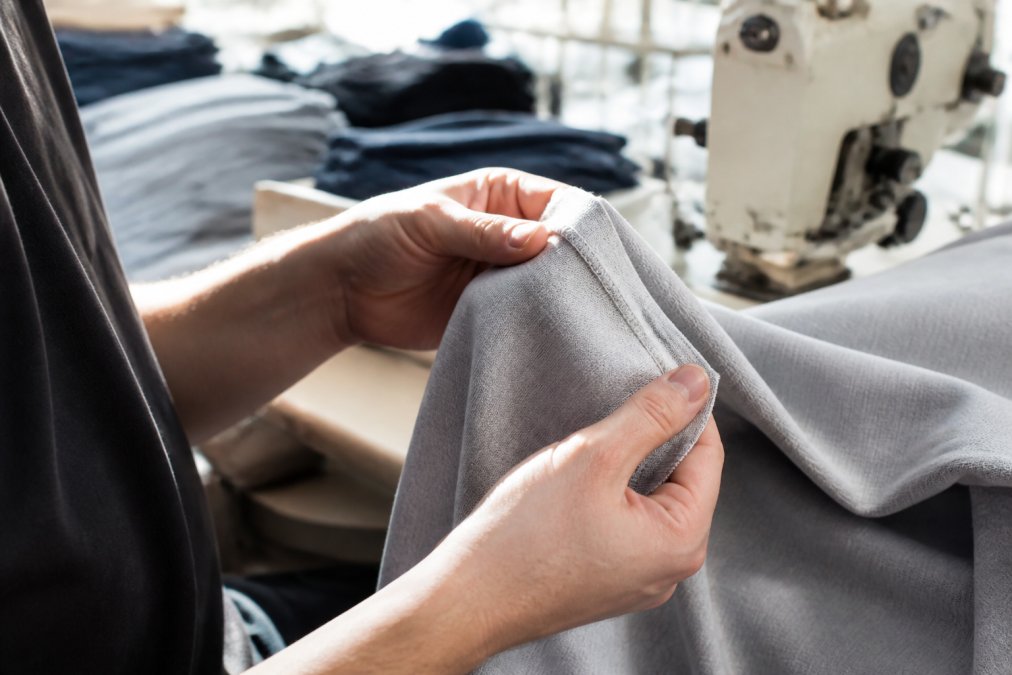
A team producing 100 garments per week can inspect each piece thoroughly, catching inconsistencies missed in facilities churning out 10,000 daily. Quality is visible and measurable at human scale.
Small batch production allows manufacturers to build institutional knowledge. Makers become familiar with each design's requirements and optimal techniques, resulting in consistently better products.
For Nested Peak, made-to-order manufacturing means every piece is a small batch. We design and finish each garment knowing quality directly impacts customer satisfaction and brand reputation.
NP 10 Perfect Weight Ican Tee – Men's →
Sustainable Fashion Manufacturing Practices That Reduce Risk
Sustainability and risk reduction are deeply connected in small batch clothing production. Overproduction creates waste, destroys margins, and forces corner-cutting on labor and materials. Small batch approaches create space for ethical manufacturing: brands can work with suppliers prioritizing fair labor, source materials thoughtfully, and invest in quality processes.
Smaller batches allow brands to maintain visibility over their entire production process, from raw materials to finished garments, essential for ensuring ethical labor and environmental responsibility.
Reducing inventory risk reduces pressure to sell at any cost. Brands with massive unsold inventory resort to deep discounting, undermining positioning. Small batch clothing production eliminates this: pricing reflects actual value rather than desperation.
Flexibility, Customization, and Market Testing Benefits
Launch a limited edition with 100 units, track sales and feedback. If it resonates, expand the next batch. If it underperforms, pivot without financial catastrophe, replacing mass production's all-or-nothing bet.
Customization becomes feasible at small batch scale. Customers can request specific colors, fits, or modifications without disrupting schedules or forcing manufacturers to produce hundreds of extras.
Brand agility flows from this flexibility. Small batch manufacturers respond to trends in weeks, testing new categories and materials without massive capital commitment, increasingly valuable as trend cycles accelerate.
Customers appreciate limited editions and exclusive designs. Small batch clothing production creates genuine scarcity from lower volumes, resonating with consumers who value exclusivity and craftsmanship.

Financial Modeling and Cost-Efficiency for Startups
For startups with limited capital, small batch clothing production is often the only viable path. Mass production requires hundreds of thousands in inventory financing; small batch requires far less and allows validation before scaling.
Capital requirements and cash flow modeling: Mass production requires $10,000-$15,000 minimum (design, sampling, 1,000-unit run at $10/unit). Small batch pre-order model requires $2,000-$3,000 (design, sampling, 100 pre-orders at $45 retail). Made-to-order model requires $2,000 (sampling only; customer payment covers production).
Cost-per-unit breakdown and pricing strategy: Mass production (1,000 units): $9.50 cost per unit, $15 wholesale, $30 retail (57% margin). Small batch (100 units): $12.50 cost per unit, $45 retail (72% margin). Per-unit cost is higher, but retail price is higher due to premium positioning. Profitability on 80 sold units ($3,600 revenue, $1,000 cost) exceeds 700 units from mass production ($10,500 revenue, $9,500 cost), while requiring 10x less capital.
Scaling without capital infusions: Production volume increases naturally with demand. Year 1: 50 units/month at $12.50 cost, $45 retail. Year 2: 150 units/month at $11.50 cost. Year 3: 300 units/month at $10.50 cost. Gradual scaling improves margins without capital events.
Break-even analysis and unit economics: Fixed costs of $5,000/quarter and $12.50 variable cost require 154 units/quarter (50/month) to break even at $45 retail. Small batch brands achieve this in 6-12 months. Mass production brands with $50,000 quarterly fixed costs need 1,500+ units, a much higher bar.
Risk-adjusted return on investment: Small batch production reduces downside risk dramatically. If a design underperforms, you've lost $1,500, not $10,000. If it succeeds, scale in the next batch without new negotiations. This asymmetric risk, limited downside, unlimited upside, is ideal for testing product-market fit with minimal capital.
Frequently Asked Questions
What are the primary benefits of small batch clothing production?
Small batch clothing production reduces overproduction and deadstock, cuts textile waste, improves quality control through careful craftsmanship, and allows brands to test designs before committing to larger runs. It also enables faster turnaround times and reduces inventory risk—critical for startups managing cash flow. Made-to-order and small batch approaches align production with actual demand, meaning less capital tied up in unsold inventory.
How does small batch manufacturing reduce textile waste compared to mass production?
Mass production typically generates excess fabric, deadstock, and overproduction waste. Small batch production aligns output with real demand, eliminating the need to manufacture thousands of units that may never sell. This approach reduces waste reduction directly—fewer items produced means fewer items end up in landfills. Brands can also test sustainable textile sourcing and ethical labor practices at smaller scales before scaling up, refining supply chain transparency and reducing environmental impact.
Is small batch production really higher quality than mass production?
Small batch production typically delivers higher quality because of tighter quality assurance processes and greater attention to detail. Smaller production runs allow manufacturers to focus on craftsmanship, catch defects early, and maintain consistent standards. Mass production prioritizes speed and volume, which often means quality checks are faster and less rigorous. Small batch operations can also source better materials and invest in skilled labor, resulting in garments that last longer and perform better—justifying the premium price point.
How does small batch production help brands manage inventory risk?
Small batch production lets brands test designs and measure customer demand before committing to large production runs. This reduces the risk of overproduction—manufacturing thousands of units that don't sell ties up capital and creates waste. By starting with smaller quantities, brands can validate market demand, adjust designs based on feedback, and scale production only for proven winners. This approach is especially valuable for startups with limited budgets and for testing limited edition or seasonal collections.